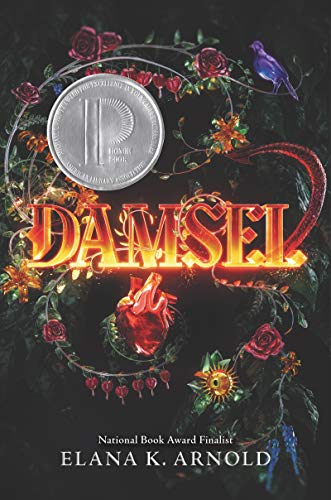
The rite has existed for as long as anyone can remember. When the king dies, his son the prince must venture out into the gray lands, slay a fence dragon, and rescue a damsel to be his bride. This is the way things have always been.
When Ama wakes in the arms of Prince Emory, she knows none of this. She has no memory of what came before she was captured by the dragon or what horrors she faced in its lair. She knows only this handsome young man, the story he tells of her rescue, and her destiny of sitting on a throne beside him. It’s all like a dream, like something from a fairy tale.
As Ama follows Emory to the kingdom of Harding, however, she discovers that not all is as it seems. There is more to the legends of the dragons and the damsels than anyone knows, and the greatest threats may not be behind her, but around her, now, and closing in.
This is another one I picked up at Dandelion Bookshop during my trip to the Chicago area over the summer and if I read a new book before putting it on my to-be-read shelf, then I technically haven’t bought too many books. Right? Right?!
Also, I was on vacation so of course I had to buy some fun vacation books. Not that memoirs and nonfiction books about psychology, religion, and trauma (and religious trauma) can’t be fun. But they usually don’t have dragons.
Damsel by Eliana K. Arnold has a dragon. It is, however, decidedly not fun, as I discovered. After reading the first few chapters, I texted my friend (the wonderful owner of Dandelion Bookshop who has a magical talent for recommending good books) that I was LOVING the book—it’s very beautifully written and full of emotion with a great tone and vivid characters. My friend texted back that she loved the book too even though it wasn’t the kind of book she usually liked.
That confused me since it seemed like a fun, girl-power, turn-the-narrative-on-its-head kind of YA fantasy book, and who doesn’t like that kind of book? Plus my friend writes and reads tons of MG/YA, so it’s not outside her genre.
But then I kept reading. And it was all those things it seemed to be in the beginning, but just, like, the death metal equivalent of a fun, girl-power, YA fantasy book. It got dark. So dark. But also a good kind of dark, the page-turning, makes you think, kind of dark.
I found myself wanting relief throughout the book though. I wanted just one thing to go well for Ama, one thing to be soft about her life in the castle, one person to be kind, one obstacle she didn’t have to overcome all on her own. I wanted a joke. I can write some dark things, but darned if they aren’t also funny. I don’t think I could read my own work if I hadn’t made it funny. Maybe I’m emotionally avoidant? Uncomfortable with strong feelings? Unable to tolerate conflict and discomfort? Yes, yes, and yes.
Damsel also felt angry, but productively angry, which I thought about for a while: anger as productive, not destructive. I hate being angry and I hate when other people are angry. It makes me feel uncomfortable. (I am the cliched peace-keeper middle child.) I’m afraid of anger’s tendency to be dysregulated. But productive? Yeah, I guess I could see that. And I could see how that could be good. Isn’t anger a release? Maybe that is the book’s relief that I was missing because of my deep-seated avoidance of anger.
Raised in traditional Christianity, anger was not encouraged. You were supposed to forgive. Only the Old Testament God got to be angry and even God’s anger tended to be glossed over with the razzle dazzle misdirection of the Gospels. Even in mental health spaces, forgiveness is often set forward as a goal, or proof, of healing.
What is the relationship between forgiveness and anger? Where does productivity fit into that relationship? Does forgiveness heal anger? Does engaging anger lead to forgiveness? What happens when forgiveness is an avoidance of anger? Can you truly forgive if you don’t get angry? Does anger ever go away? Can it be avoided? If so, how many jokes, exactly, does that take? It can be a healthy option to neither get angry nor forgive and just make jokes about things. Right? Right?!
The quote I loved from the book actually has nothing to do with anger or darkness. It has to do with creation: “Where did these things come from? Her past? Her dreams? It felt, as she worked the glass and the fire, that she was doing more than making objects. It was as if she was forming her very self out of the flames and hot soft glass. She was, Ama thought, realizing herself—that is to say, as she worked with the glass, she was making her very self more real.” (pg 252)
As a writer, there’s an obvious connection between making yourself as you make your art. Writing makes inner things into physical words and pages. I think about forgiveness and anger and darkness and how they’re inner things, but also interpersonal things. How do we make inner things physical through our actions with other people and how do those actions then make ourselves? How do darkness and anger correlate with—support, even—creation?
 Amy C. Lutz